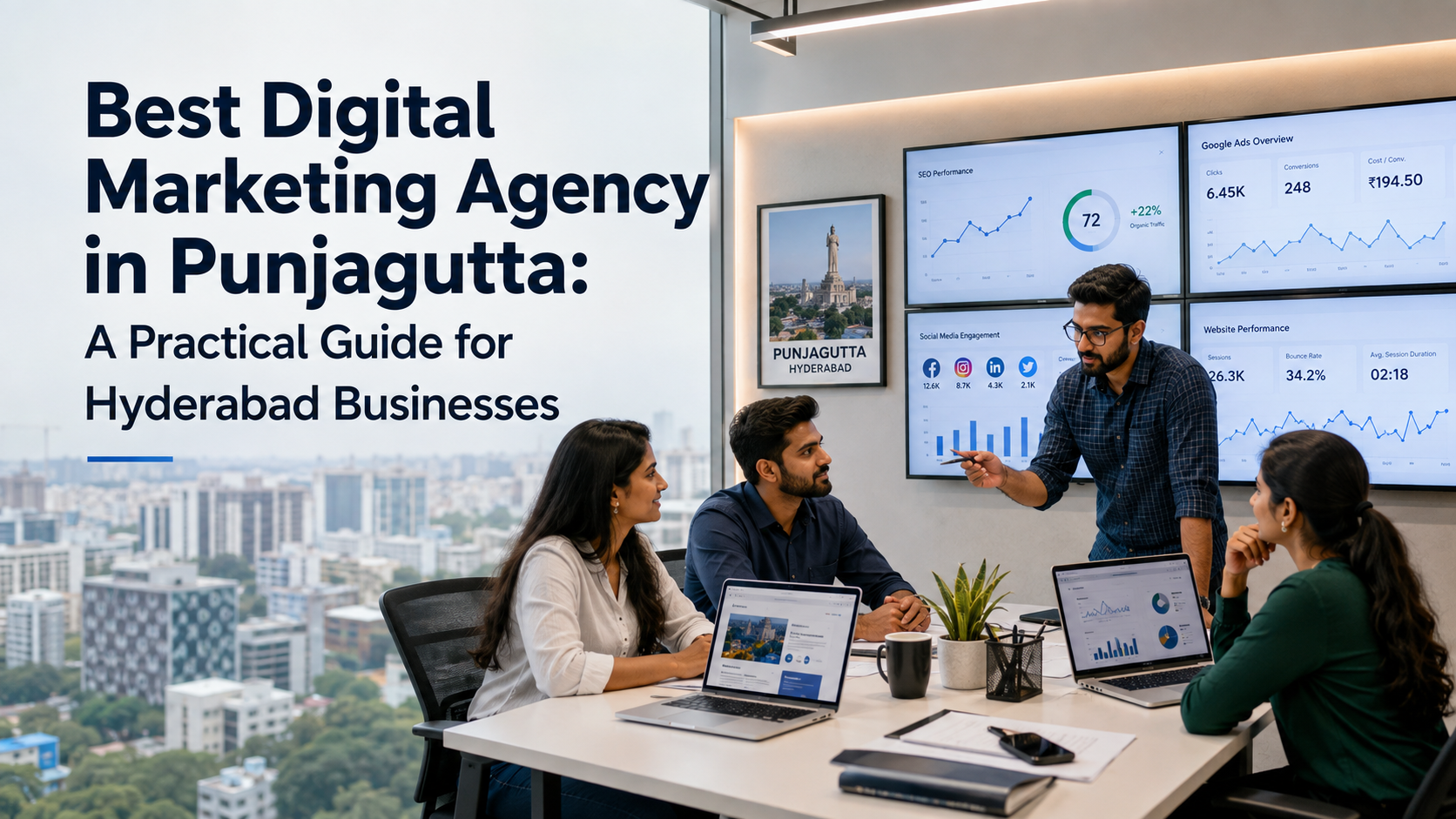
Best Digital Marketing Agency in Punjagutta: A Practical Guide for Hyderabad Businesses
Choosing the best digital marketing agency in Punjagutta is not about finding the company with the loudest promises, the largest follower count, or the lowest monthly quotation. It is about finding a team that understands your business, attracts the right audience, measures what happens after every click, and steadily improves the quality of your enquiries.
For businesses in Punjagutta and nearby areas of Hyderabad, digital marketing has a strong local dimension. A hospital near Punjagutta Metro Station, a retailer serving Somajiguda, a professional consultant in Banjara Hills, and a real estate company targeting customers across Hyderabad may all require different strategies.
The channels may be similar—SEO, Google Ads, Meta Ads, Google Business Profile, content marketing, social media, and website development—but the execution should never be identical.
Anandavihar is a digital marketing agency serving businesses in Punjagutta and across Hyderabad. Its approach combines local market understanding, search visibility, paid advertising, website performance, conversion tracking, and continuous optimisation. Instead of treating digital marketing as a collection of disconnected activities, the focus is on building a measurable system that turns online attention into genuine business opportunities.
Quick answer:
The best digital marketing agency in Punjagutta should understand your local market, define clear business goals, track leads accurately, communicate transparently, and improve campaigns using real performance data. Anandavihar provides SEO, Google Ads, Meta Ads, local SEO, website development, social media marketing, content marketing, and performance-focused digital strategy for Hyderabad businesses.
Table of Contents
- What makes a digital marketing agency the best?
- Why Punjagutta businesses need a local digital strategy
- How customers search for businesses in Hyderabad
- Services a capable digital marketing agency should provide
- SEO and organic search visibility
- Google Business Profile and local SEO
- Google Ads and paid search
- Meta Ads and social media advertising
- Website design and conversion optimisation
- Content marketing, AEO, and GEO
- Analytics, tracking, and reporting
- Agency versus freelancer versus in-house team
- How to evaluate a digital marketing agency
- Digital marketing pricing in Punjagutta
- Common mistakes businesses make
- How Anandavihar approaches digital marketing
- Why choose Anandavihar?
- A practical 90-day marketing roadmap
- AI Overviews, entity SEO, and brand authority
- Internal and external linking recommendations
- Schema markup recommendations
- Frequently asked questions
- Final recommendation
What Makes a Digital Marketing Agency the Best?
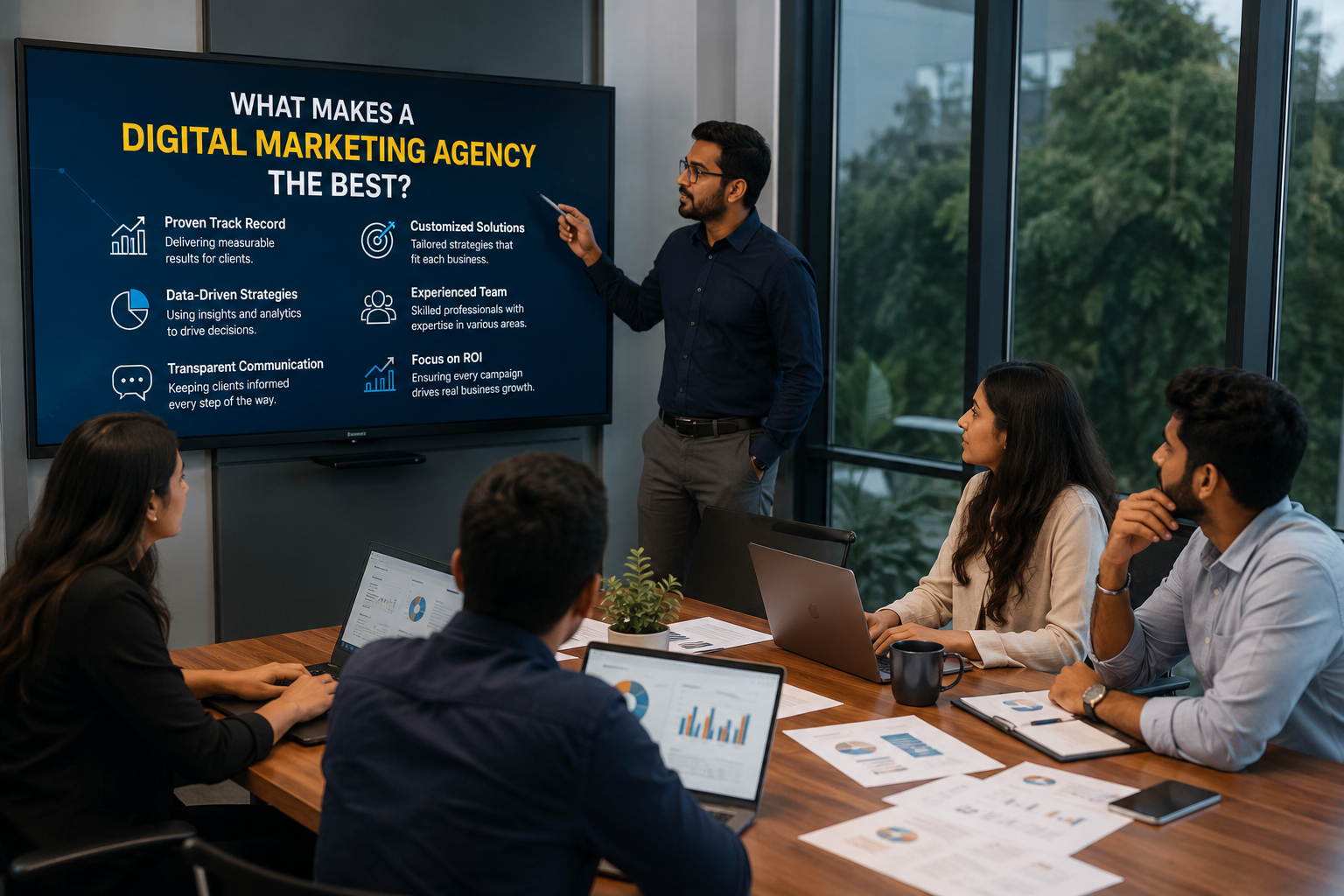
meaningful business outcomes.
That sounds obvious, but many businesses still receive reports filled with impressions, reach, clicks, followers, and page views without knowing whether those numbers resulted in phone calls, qualified leads, appointments, sales, store visits, or revenue.
A good agency should be able to answer five basic questions:
- Who is the ideal customer?
- Where does that customer search or spend time online?
- What message will encourage the customer to act?
- How will each enquiry or sale be tracked?
- What will be improved when the results are below expectations?
If an agency cannot answer these questions clearly, adding more advertising budget rarely solves the problem.
The Best Agency Is Not Always the Biggest
A large agency may have more employees, but that does not automatically mean it will provide closer attention. A smaller specialist agency may understand your local audience more deeply and respond faster when a campaign needs correction.
The right choice depends on:
- Your business model
- Your average customer value
- Your target location
- Your available advertising budget
- Your sales cycle
- Your internal team
- The speed at which you need results
- The quality of your website and offer
A clinic may need appointment enquiries. A school may need admission calls. A photographer may need wedding or commercial bookings. A real estate company may need verified buyer leads. An e-commerce brand may need profitable purchases rather than general website traffic.
Each business requires a different definition of success.
What “Best” Should Mean for Your Business
| Evaluation Area | What a Good Agency Should Demonstrate |
| Strategy | A plan connected to business goals |
| Local knowledge | Understanding of Hyderabad and nearby customer behaviour |
| SEO | Ability to improve relevant search visibility |
| Paid advertising | Structured campaigns with proper targeting and tracking |
| Website performance | Fast, mobile-friendly, conversion-focused pages |
| Reporting | Clear explanation of results and next actions |
| Communication | Regular, honest, understandable updates |
| Optimisation | Continuous testing and improvement |
| Transparency | Clear fees, deliverables, access, and ownership |
| Lead quality | Focus on genuine prospects, not only lead volume |
Consultant’s note:
A campaign producing 100 weak leads may be less valuable than a campaign producing 20 enquiries from people who genuinely need your service and can afford it.
Why Punjagutta Businesses Need a Local Digital Strategy
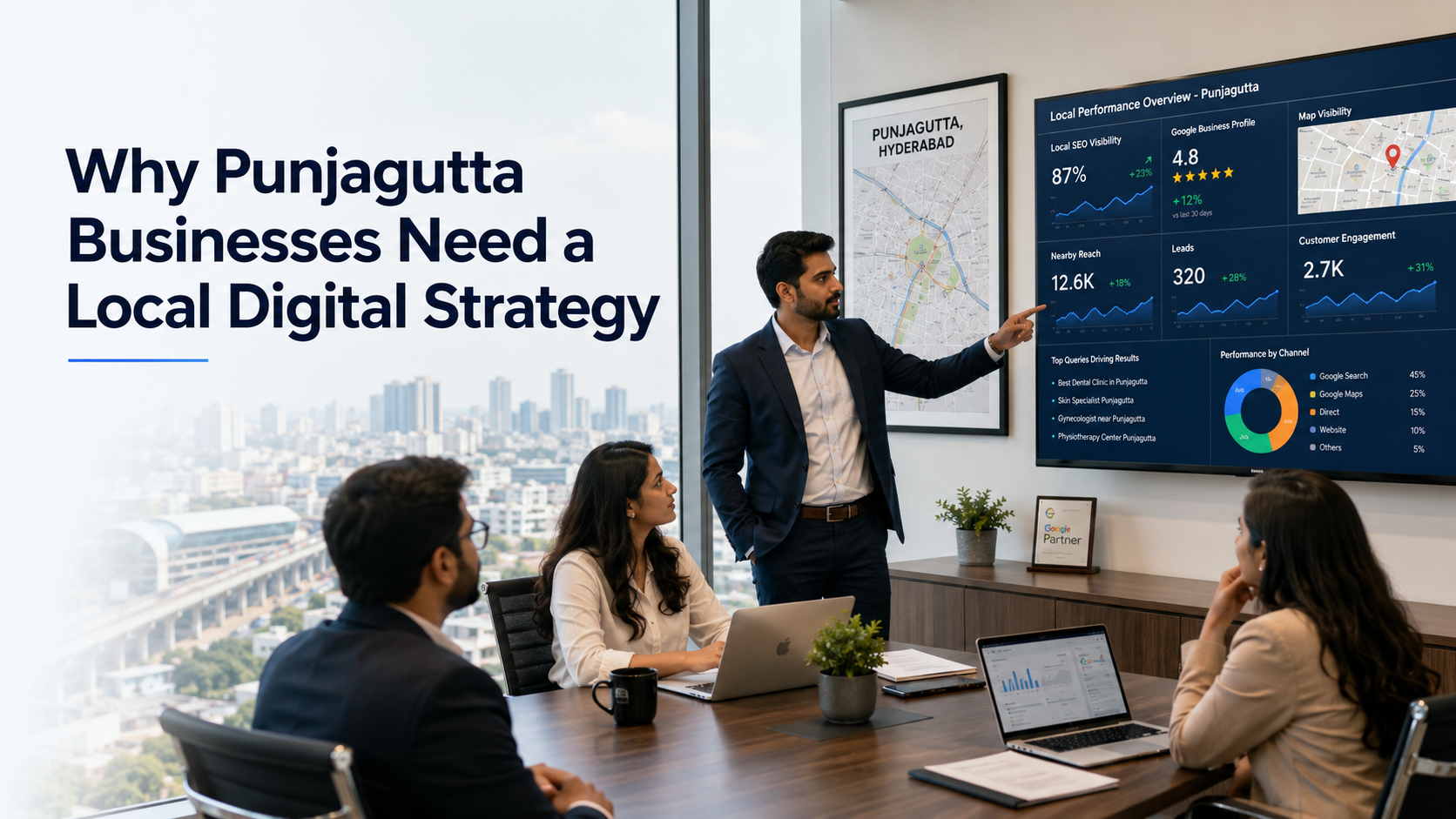
A Punjagutta business needs a digital strategy that reflects how people move, search, compare, and buy within central Hyderabad.
Punjagutta is connected to several active commercial and residential areas, including Somajiguda, Ameerpet, Banjara Hills, Begumpet, Khairatabad, Srinagar Colony, SR Nagar, Jubilee Hills, and surrounding parts of Hyderabad. It is accessible by road and metro, making it relevant to customers beyond the immediate neighbourhood.
That accessibility creates opportunity, but it also increases competition.
A customer searching for a clinic, coaching centre, restaurant, marketing agency, interior designer, lawyer, salon, or real estate consultant may compare businesses across several nearby locations before making contact. Being physically close is useful, but proximity alone does not guarantee that your business will be noticed or trusted.
Local Visibility Is More Than Ranking for One Keyword
A strong local strategy may target searches such as:
- Digital marketing agency in Punjagutta
- Best digital marketing agency in Punjagutta
- Digital marketing company near Punjagutta
- SEO agency in Punjagutta
- Google Ads agency in Punjagutta
- Social media marketing agency in Punjagutta
- Digital marketing agency near me
- Best digital marketing agency in Hyderabad
- Performance marketing agency in Hyderabad
These searches have different levels of intent.
Someone searching “what is digital marketing?” is probably researching. Someone searching “digital marketing agency near me” may be actively comparing providers. Someone searching “Google Ads agency in Punjagutta” has already identified a specific requirement.
A capable agency creates content for each stage instead of forcing every visitor onto one general service page.
Hyderabad Customers Often Compare Before Contacting
Before calling a business, customers may review:
- Google Business Profile information
- Website quality
- Service pages
- Reviews and owner responses
- Social media activity
- Photos and videos
- Pricing information
- Case studies
- Frequently asked questions
- Location and travel convenience
- WhatsApp availability
- Response speed
This means your visibility, reputation, website, advertising, and communication process must work together.
A business may rank well but lose enquiries because its website looks outdated. Another may have an attractive website but no local visibility. A third may generate leads through ads but fail to respond quickly.
Digital marketing works best when the entire customer journey is considered.
How Customers Search for Businesses in Hyderabad
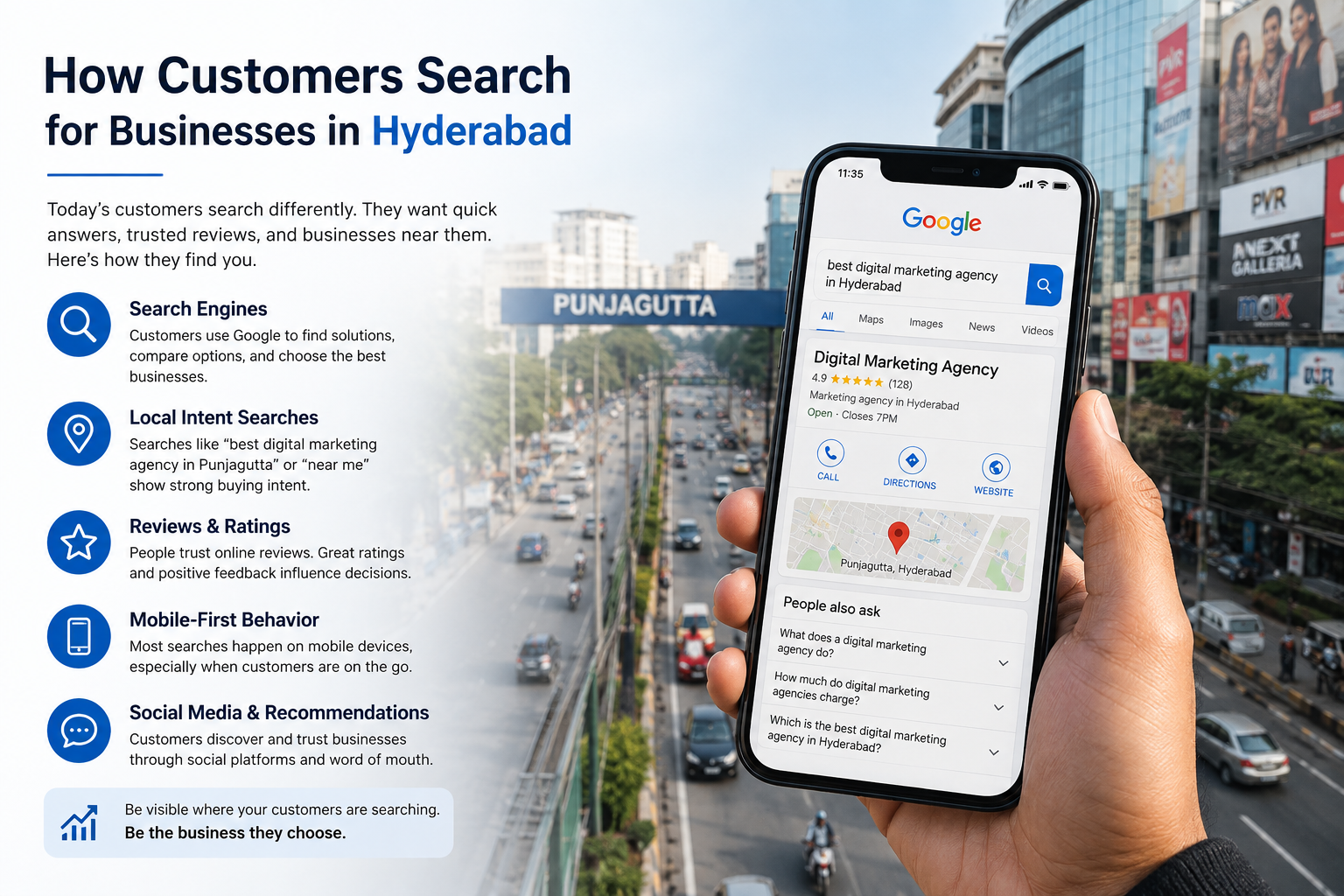
Customers generally search using a combination of service, location, urgency, trust, and price.
Typical search patterns include:
- Service-based: “SEO services”
- Location-based: “SEO agency in Punjagutta”
- Trust-based: “best SEO company in Hyderabad”
- Problem-based: “why my website is not ranking”
- Urgency-based: “Google Ads expert near me”
- Price-based: “digital marketing agency cost in Hyderabad”
- Comparison-based: “SEO vs Google Ads for local business”
- Brand-based: “Anandavihar digital marketing agency”
- Voice-search style: “Which is the best digital marketing agency near Punjagutta?”
A complete strategy should address several of these patterns.
Mobile Search Matters
Local searches frequently happen on mobile devices. Users may be travelling, sitting in an office, comparing service providers between meetings, or searching after receiving a recommendation.
A mobile visitor expects:
- Fast loading
- Easy-to-read content
- A visible phone number
- A WhatsApp button
- Simple forms
- Clear directions
- Relevant service information
- Trust signals
- No intrusive pop-ups
A website that performs well on desktop but frustrates mobile users can lose valuable enquiries.
Search Behaviour Changes by Industry
Healthcare
Patients may search by treatment, doctor specialisation, location, timings, reviews, or appointment availability.
Education
Parents may search by curriculum, admissions, fees, facilities, location, reviews, and academic reputation.
Real Estate
Buyers may search by property type, budget, location, project status, developer, amenities, and possession date.
Professional Services
Business owners may compare expertise, experience, consultation process, industry understanding, and past work.
Retail and Hospitality
Customers may focus on location, availability, photos, reviews, offers, timings, and directions.
The agency you choose should understand these differences before recommending channels or budgets.
What Does a Digital Marketing Agency Do?
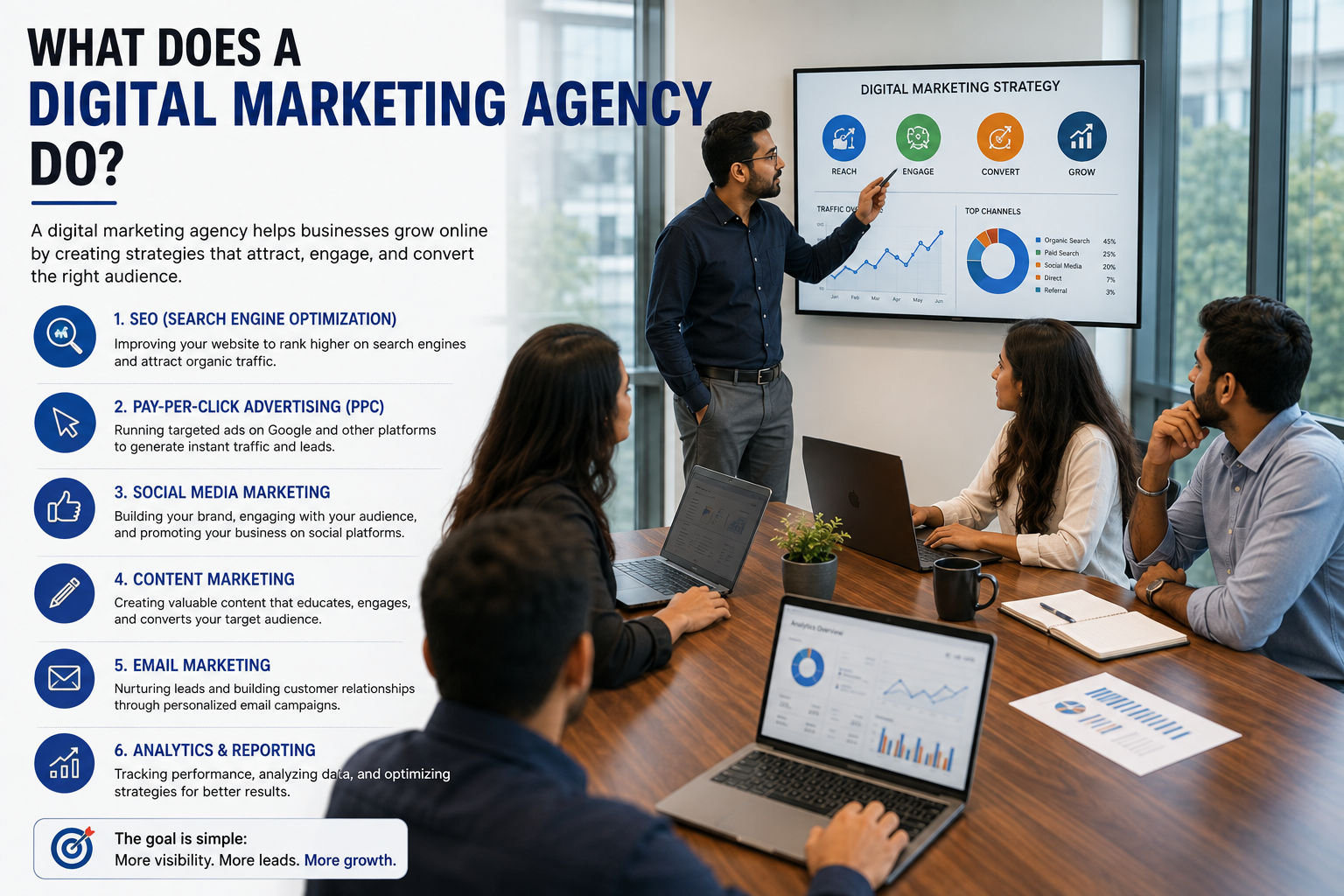
A digital marketing agency helps businesses attract, engage, and convert customers through online channels.
Its work may include search engine optimisation, paid advertising, social media, content development, website design, local search optimisation, analytics, conversion tracking, and campaign strategy.
The important point is not how many services are offered. It is how well those services are connected.
For example:
- SEO brings relevant visitors from search engines.
- The website explains the offer and builds trust.
- Conversion tracking records calls, forms, WhatsApp enquiries, or purchases.
- Remarketing reaches visitors who did not convert.
- Content answers objections and supports future searches.
- Analytics reveals which channels and campaigns produce better outcomes.
When these activities are managed separately without a common strategy, businesses often waste money.
Essential Digital Marketing Services for Punjagutta Businesses
A capable digital marketing agency should recommend services based on your business needs rather than selling the same package to every client.
|
Service |
Primary Purpose |
Typical Business Outcome |
|
SEO |
Improve organic search visibility |
Relevant website traffic and enquiries |
|
Local SEO |
Improve visibility in local and map-based searches |
Calls, directions, local leads |
|
Google Ads |
Reach people actively searching |
High-intent enquiries |
|
Meta Ads |
Build demand and reach targeted audiences |
Leads, awareness, sales, remarketing |
|
Website development |
Create a credible digital destination |
Better engagement and conversions |
|
Landing pages |
Match specific campaigns and offers |
Higher conversion efficiency |
|
Social media marketing |
Build familiarity and audience engagement |
Brand awareness and community |
|
Content marketing |
Educate users and build authority |
Search visibility and trust |
|
Conversion tracking |
Measure customer actions |
Better decision-making |
|
Performance marketing |
Optimise spending around measurable outcomes |
Improved lead or sales efficiency |
Search Engine Optimisation for Sustainable Growth
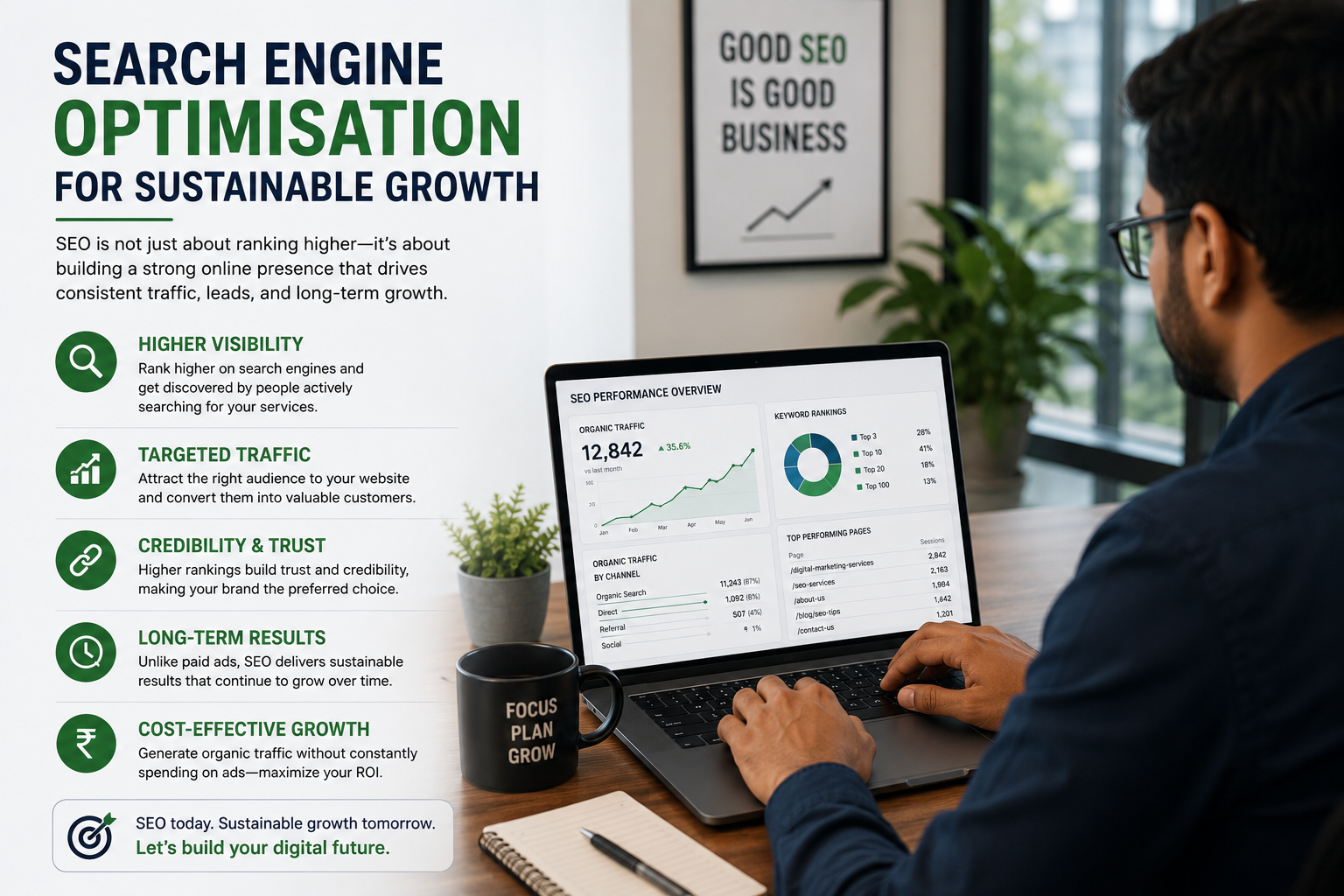
SEO improves a website’s ability to appear in relevant search results.
It is not simply the act of placing keywords into pages. Effective SEO combines technical health, content quality, search intent, authority, user experience, local relevance, internal linking, and clear website structure.
Google’s Search Essentials provides foundational guidance on technical requirements, spam policies, and practices that help Google understand and access website content.
Why SEO Matters
SEO can help a business:
- Build long-term visibility
- Attract customers already searching for relevant services
- Reduce total dependence on paid advertising
- Improve website structure and usability
- Establish subject expertise
- Strengthen brand credibility
- Reach customers across multiple stages of the buying journey
SEO should be treated as a cumulative business asset. A useful service page, local landing page, comparison article, or detailed guide may continue attracting visitors long after it is published.
What a Strong SEO Strategy Includes
Technical SEO
Technical SEO helps search engines discover, crawl, render, understand, and index a website.
Important areas include:
- Indexability
- XML sitemaps
- Robots directives
- Canonical tags
- HTTPS
- Mobile usability
- Redirect management
- Broken links
- Page speed
- Structured data
- Duplicate content
- JavaScript rendering
- URL structure
Technical improvements are valuable, but they cannot compensate for weak content or an unclear offer.
On-Page SEO
On-page SEO improves the relevance and clarity of individual pages.
It includes:
- Descriptive page titles
- Useful meta descriptions
- Logical headings
- Relevant primary and secondary topics
- Clear service information
- Internal links
- Image alt text
- Helpful FAQs
- Local references
- Strong calls to action
- Accurate business information
The goal is not to repeat “best digital marketing agency” throughout the page. The goal is to answer the questions a serious buyer would ask before contacting an agency.
Content Strategy
Content should support customer decisions, not merely increase the number of indexed pages.
Useful topics for a digital marketing agency may include:
- How much does digital marketing cost in Hyderabad?
- SEO versus Google Ads: which should a local business choose?
- How long does local SEO take?
- Why are Meta Ads generating low-quality leads?
- How should a business measure marketing ROI?
- What should a landing page include?
- How can Hyderabad businesses improve Google Maps visibility?
- What is AEO, and how is it different from SEO?
- How can a brand appear in AI-generated answers?
Each article should connect to relevant service pages and guide readers toward a logical next step.
Off-Page SEO and Brand Mentions
Off-page SEO includes signals and references that exist beyond your website.
These may include:
- Relevant business directories
- Industry publications
- Local citations
- Digital PR
- Partnerships
- Genuine customer reviews
- Expert contributions
- Interviews
- Event listings
- Unlinked brand mentions
- Relevant backlinks
Quality matters more than volume. Hundreds of unrelated directory links rarely build meaningful authority.
SEO Mistakes to Avoid
- Publishing thin pages for every minor keyword variation
- Repeating location names unnaturally
- Buying large quantities of low-quality backlinks
- Copying competitor content
- Creating blogs without internal links
- Ignoring indexing problems
- Using misleading titles
- Publishing unverified claims
- Allowing outdated contact details to remain online
- Measuring SEO only through rankings
Rankings matter, but leads, engagement, conversions, and business relevance matter more.
Local SEO and Google Business Profile Optimisation
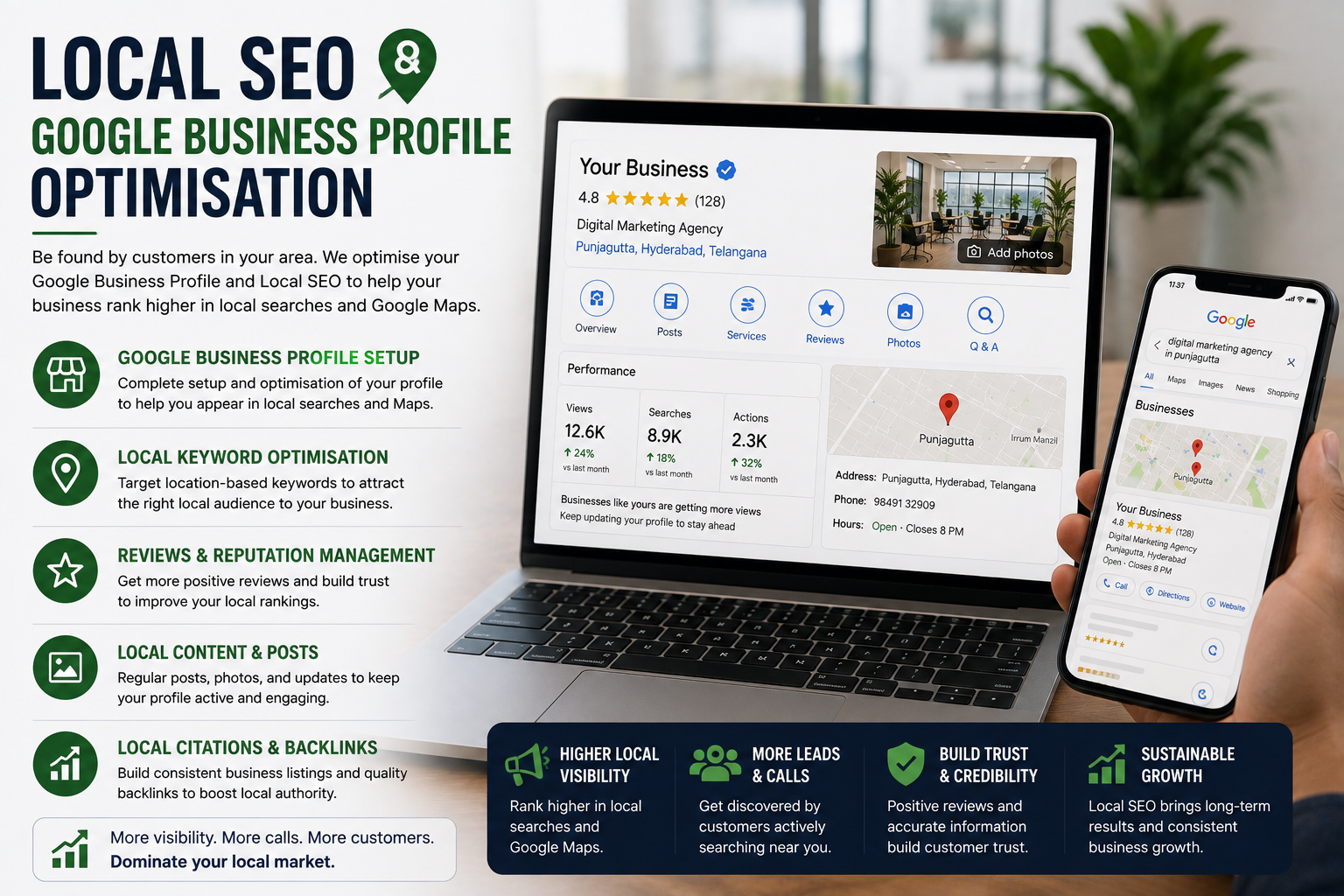
Local SEO helps a business appear when customers search within a specific geographic area.
For a Punjagutta business, this may include visibility in standard search results, Google Maps, local results, and location-based queries.
A well-managed Google Business Profile can support calls, website visits, direction requests, review activity, and customer trust.
What Google Business Profile Optimisation Includes
- Correct business name
- Accurate primary and secondary categories
- Updated address or service-area information
- Correct phone number
- Website link
- Opening hours
- Service information
- Business description
- High-quality photographs
- Relevant posts
- Questions and answers
- Review monitoring
- Professional review responses
- Product or service entries where applicable
- Consistent business details across the web
The Google Business Profile Help Center provides official guidance on profile management, eligibility, edits, reviews, and business information.
Why Consistency Matters
Your business name, address, phone number, website, and category details should be consistent across important platforms.
Conflicting information can confuse both customers and search systems. It may also lead to missed calls, incorrect directions, or reduced trust.
Reviews and Reputation
Reviews influence how potential customers perceive a business, but they should be earned ethically.
Businesses should never purchase reviews or pressure customers to publish misleading feedback. Instead, create a simple process that asks genuine customers to share honest experiences.
A professional response to a review should:
- Thank the customer.
- Refer naturally to the service provided.
- Avoid repeating keywords mechanically.
- Address concerns respectfully.
- Protect private customer information.
- Encourage further communication where appropriate.
Local Content Opportunities
A Punjagutta business can create useful content around:
- Services available in Punjagutta
- Areas served across Hyderabad
- Directions and accessibility
- Frequently asked local questions
- Industry-specific guides
- Local events or workshops
- Customer concerns specific to the market
- Neighbourhood comparisons where relevant
Local content should be genuinely useful. Adding place names to generic content does not create local authority.
Google Ads for High-Intent Customer Acquisition
Google Ads helps businesses reach people who are actively searching for products or services.
It can generate enquiries faster than SEO, but speed does not guarantee profitability. Campaign structure, keyword intent, ad relevance, landing-page quality, tracking, budget control, and sales follow-up all influence the outcome.
When Google Ads Works Well
Google Ads is often useful when:
- Customers already search for the service
- The business can respond quickly
- The offer is commercially attractive
- The landing page is relevant
- Conversions are tracked correctly
- The sales team can qualify enquiries
- The budget is sufficient for meaningful testing
Core Components of a Search Campaign
- Campaign structure
- Location targeting
- Keyword selection
- Match-type strategy
- Negative keywords
- Ad copy
- Ad assets
- Landing pages
- Conversion tracking
- Bid strategy
- Search-term analysis
- Ongoing optimisation
Why Search Intent Matters
Consider these searches:
- “What is SEO?”
- “SEO course”
- “SEO jobs”
- “SEO agency in Punjagutta”
- “Hire SEO company Hyderabad”
All contain “SEO,” but their commercial intent is different.
An agency should separate informational, educational, employment, and service-related searches. Otherwise, the advertising budget may be spent on people who were never potential customers.
Landing Pages Should Match the Advertisement
A person clicking an advertisement for Google Ads management should not be sent to a general homepage that barely mentions Google Ads.
The landing page should explain:
- Who the service is for
- The problems it solves
- What the process includes
- What makes the agency credible
- What the next step is
- How the visitor can call, message, or enquire
Google Ads Mistakes to Avoid
- Running campaigns without conversion tracking
- Using broad targeting without control
- Sending all traffic to the homepage
- Ignoring search terms
- Measuring success by clicks alone
- Advertising outside the actual service area
- Using the same message for every audience
- Failing to exclude irrelevant searches
- Changing campaigns too frequently without enough data
- Generating leads without a follow-up process
Meta Ads for Demand Generation and Remarketing
Meta Ads help businesses reach audiences across Facebook and Instagram using demographic, behavioural, interest-based, custom, and first-party audience signals.
Unlike Google Search, Meta advertising often reaches people before they actively search for a solution. This means the creative, offer, message, and audience context play a major role.
When Meta Ads Are Useful
Meta Ads can support:
- Lead generation
- E-commerce sales
- Event promotion
- Course admissions
- Real estate enquiries
- Brand awareness
- Appointment campaigns
- Product launches
- Video engagement
- Remarketing
- WhatsApp conversations
Creative Quality Influences Performance
A campaign can have technically correct targeting and still perform poorly because the creative does not capture attention or explain value.
Effective advertisements often include:
- A recognisable problem
- A specific benefit
- A clear audience
- A credible offer
- A visual that suits the platform
- A direct call to action
- A reason to act now without false urgency
Lead Quality Requires More Than Targeting
Low-quality leads may result from:
- An overly broad offer
- Unclear pricing expectations
- Weak qualifying questions
- Misleading creative
- Accidental form submissions
- Slow follow-up
- Poor audience-message alignment
- An offer attracting bargain hunters
- Lack of location filtering
- Incorrect campaign objectives
A good agency examines the complete process instead of blaming the platform after a few days.
Meta Ads and Remarketing
Remarketing allows a business to reach people who previously:
- Visited the website
- Viewed a service page
- Engaged with social content
- Watched a video
- Opened a lead form
- Added a product to the cart
- Contacted the business
- Entered a customer database, subject to lawful data use
Remarketing is most effective when messages reflect the customer’s level of awareness. Someone visiting a pricing page may need a different message from someone who only watched a short video.
Social Media Marketing and Brand Familiarity
Social media marketing helps a business communicate consistently, demonstrate expertise, show its personality, and remain familiar to potential customers.
It should not be judged only by follower growth.
A smaller audience containing real customers, prospects, partners, and local stakeholders may be more valuable than a large but irrelevant following.
A Practical Content Mix
A service business can publish:
- Educational posts
- Common customer questions
- Service explanations
- Behind-the-scenes content
- Team expertise
- Customer feedback
- Process demonstrations
- Industry observations
- Short videos
- Case-study formats using verified information
- Offers and announcements
- Local updates
What Social Media Should Achieve
Social media can help:
- Build recognition before the customer needs the service.
- Strengthen trust after the customer discovers the business through search.
- Answer common objections.
- Demonstrate that the business is active.
- Support remarketing audiences.
- Create material that can be reused on websites, advertisements, and Google Business Profile.
Posting daily without a clear purpose is not automatically better than publishing fewer, stronger pieces.
Website Development and Conversion Optimisation
Your website should help visitors understand, trust, and contact your business.
A visually attractive website is useful, but appearance alone does not produce results. The website must also be fast, clear, mobile-friendly, searchable, accessible, persuasive, and easy to navigate.
What a High-Converting Website Needs
- Clear value proposition
- Relevant service pages
- Location information
- Visible calls to action
- Fast loading
- Mobile responsiveness
- Easy navigation
- Trust signals
- Genuine testimonials
- Clear contact options
- WhatsApp and phone access
- Secure browsing
- Useful FAQs
- Privacy information
- Proper tracking
- Search-friendly structure
Core Web Vitals
Core Web Vitals are performance measurements related to loading experience, visual stability, and responsiveness. They are useful indicators of page experience, but passing them does not guarantee high rankings.
Businesses can test pages using PageSpeed Insights. Improvements should focus on real user experience rather than chasing a score without understanding the underlying problem.
Common performance issues include:
- Oversized images
- Excessive scripts
- Heavy animation
- Poor hosting
- Unused plugins
- Render-blocking resources
- Unoptimised fonts
- Large page-builder files
- Third-party widgets
- Layout shifts
Conversion Rate Optimisation
Conversion rate optimisation improves the percentage of visitors who complete a valuable action.
This may involve testing:
- Headlines
- Forms
- Buttons
- Offers
- Page length
- Social proof
- Pricing presentation
- Trust elements
- Calls to action
- Navigation
- Mobile layouts
A conversion improvement is only meaningful when it increases the right actions. More form submissions are not helpful when the submissions are mostly irrelevant.
Content Marketing, AEO, and GEO
Content marketing builds visibility and trust by answering the questions customers ask before, during, and after a buying decision.
Modern content should support traditional search engines as well as answer engines and generative systems.
What Is Answer Engine Optimisation?
Answer Engine Optimisation, or AEO, is the practice of structuring information so search engines and assistants can understand and present direct answers.
AEO-friendly content uses:
- Clear questions
- Direct answers
- Definitions
- Step-by-step explanations
- Tables
- Short summaries
- Logical headings
- FAQ sections
- Structured data where appropriate
- Consistent terminology
AEO does not replace SEO. It strengthens content clarity.
What Is Generative Engine Optimisation?
Generative Engine Optimisation, or GEO, focuses on making content understandable, trustworthy, and reference-worthy for AI-generated answers.
Platforms such as ChatGPT, Gemini, Perplexity, Claude, Microsoft Copilot, and Google’s AI-generated search experiences evaluate information across many sources. No agency can guarantee that a specific page will be cited, but brands can improve their chances by publishing clear, original, consistent, and well-supported information.
Why AI Systems Need Clear Entity Information
An entity is a recognisable person, organisation, place, product, service, or concept.
For a digital marketing agency, important entity information may include:
- Official business name
- Website
- Logo
- Service categories
- Location
- Contact information
- Founders or leadership, where publicly disclosed
- Areas served
- Social profiles
- Industry relationships
- Verified customer feedback
- Consistent brand descriptions
When this information is consistent across trusted sources, search engines can better understand the organisation and its relationships.
Entity SEO and the Knowledge Graph
Entity SEO improves how clearly a brand and its topics are represented across the web.
Google’s Knowledge Graph connects entities and relationships. A business may be associated with a location, services, team members, reviews, social profiles, and industry topics.
This is why brand consistency matters. If one platform describes a company as a software business, another as a training institute, and another as a marketing agency, systems and customers may struggle to understand the core identity.
Topical Authority
Topical authority is developed by covering a subject comprehensively and credibly.
For a digital marketing agency, that could include connected resources on:
- SEO
- Local SEO
- Google Ads
- Meta Ads
- Website conversion
- Lead generation
- Analytics
- Content strategy
- E-commerce marketing
- Industry-specific marketing
- Hyderabad market insights
The content should be interconnected through internal links and written by people who understand the subject in practice.
Content That AI Platforms Can Confidently Use
AI-ready content should:
- Make claims that can be supported.
- Avoid invented statistics.
- Define technical terms.
- Separate facts from opinions.
- Explain why a recommendation matters.
- Use consistent names and terminology.
- Include dates when freshness matters.
- Link to authoritative primary sources.
- Provide original professional insight.
- Keep important answers easy to extract.
Google Search Console, GA4, and Conversion Tracking
Measurement tells you whether marketing activity is creating meaningful progress.
Google Search Console, Google Analytics 4, advertising-platform data, call tracking, form tracking, CRM records, and sales feedback each provide a different part of the picture.
Google Search Console
Google Search Console helps website owners monitor how their sites appear in Google Search.
It can provide information about:
- Search queries
- Pages receiving impressions
- Click-through rates
- Indexing
- crawl issues
- Core Web Vitals reports
- Manual actions
- Security issues
- Links
- Structured data reports
Search Console does not report every search or every user action, but it is an essential diagnostic tool.
Google Analytics 4
Google Analytics 4 helps businesses understand website and app behaviour.
It may be configured to measure:
- Page views
- Form submissions
- Phone-link clicks
- WhatsApp clicks
- Purchases
- Bookings
- Downloads
- Scroll behaviour
- Video interactions
- Traffic sources
GA4 is not a substitute for sales data. It should be connected to business outcomes wherever possible.
Conversion Tracking
A conversion is a valuable action completed by a user.
Common conversions include:
- Phone calls
- Contact forms
- WhatsApp enquiries
- Appointment bookings
- Purchases
- Quote requests
- Brochure downloads
- Store-direction requests
- Trial registrations
- Admission enquiries
Every business should define primary and secondary conversions. A completed purchase is usually more important than a page view. A verified appointment may be more important than a button click.
What a Useful Report Should Show
A useful monthly report should answer:
- What work was completed?
- What changed?
- Which channels generated leads?
- Which campaigns used the budget?
- What was the cost per lead?
- Which leads were qualified?
- Which landing pages performed best?
- Which search terms were relevant or irrelevant?
- What problems were discovered?
- What will be changed next?
Reports should help the business make decisions, not simply prove that activity occurred.
Agency vs Freelancer vs In-House Team
The right delivery model depends on your budget, complexity, and need for specialist skills.
|
Option |
Main Advantages |
Main Limitations |
Best Suited For |
|
Freelancer |
Lower overhead, direct communication |
Limited capacity, dependent on one person |
Small projects or one specialised task |
|
Digital marketing agency |
Multiple skills, structured delivery, broader capability |
Requires careful agency selection |
Growing businesses needing integrated support |
|
In-house marketer |
Deep business knowledge, daily availability |
May lack specialist depth across all channels |
Businesses with consistent marketing workload |
|
Full in-house team |
Strong control and internal alignment |
High hiring and management cost |
Larger organisations with substantial budgets |
|
Hybrid model |
Combines internal knowledge with external expertise |
Requires clear responsibilities |
Businesses with an internal coordinator and specialist agency |
When an Agency Makes Sense
An agency may be suitable when you need several connected capabilities, such as:
- SEO and content
- Google Ads
- Meta Ads
- Landing pages
- Analytics
- Design
- Local SEO
- Conversion optimisation
Hiring individual employees for every discipline may not be practical for a small or mid-sized business.
When a Freelancer May Be Better
A freelancer can be a good choice when the requirement is narrow and clearly defined—for example, a one-time technical SEO audit, a landing-page design, or a specific tracking implementation.
The risk arises when one person is expected to manage strategy, content, advertising, design, development, analytics, and daily communication at the same level.
How to Evaluate a Digital Marketing Agency in Punjagutta
Evaluate an agency by asking practical questions about strategy, ownership, reporting, communication, and measurement.
Agency Selection Checklist
- Does the agency ask about revenue, margins, lead quality, and sales capacity?
- Does it understand your industry and local market?
- Are the proposed services connected to clear goals?
- Will you retain ownership of your website, domain, ad accounts, and data?
- Are fees and advertising budgets explained separately?
- Is conversion tracking included?
- Are reports understandable?
- Is the communication schedule clear?
- Are deliverables documented?
- Does the agency avoid guaranteed ranking claims?
- Does it explain both opportunities and limitations?
- Can it describe how leads will be qualified?
- Does it have a process for testing and optimisation?
- Will it share access to Google Search Console, GA4, and ad accounts?
- Does it use genuine reviews and ethical SEO practices?
Questions to Ask Before Hiring
What business result will this strategy support?
The answer should be more specific than “more visibility.” It may be qualified enquiries, appointment bookings, e-commerce sales, admission leads, or revenue from a particular service.
How will conversions be tracked?
The agency should explain how calls, forms, WhatsApp actions, purchases, or bookings will be measured.
Who owns the accounts?
The business should generally retain ownership or appropriate administrative access to its website, domain, Google Ads account, Meta Business assets, analytics, and search data.
What happens during the first month?
A serious agency should explain the discovery, audit, setup, research, tracking, and planning work required before aggressive scaling.
How do you evaluate lead quality?
Lead quality should be reviewed using sales feedback, not only platform numbers.
What cannot be guaranteed?
No ethical agency can guarantee a specific organic ranking, fixed lead volume, or exact return without considering competition, budget, offer quality, demand, and sales performance.
Warning Signs When Choosing an Agency
Be cautious when an agency:
- Guarantees the first position on Google
- Promises immediate SEO results
- Refuses to provide account access
- Cannot explain its reporting
- Focuses only on impressions and reach
- Recommends the same package to every business
- Avoids questions about lead quality
- Uses copied content
- Purchases suspicious reviews
- Builds unrelated backlinks in bulk
- Hides advertising costs inside management fees
- Does not discuss the landing page
- Runs ads without conversion tracking
- Blames the platform for every poor result
- Stops communicating after receiving payment
A professional agency should be confident, but not careless with promises.
How Much Does Digital Marketing Cost in Punjagutta?
Digital marketing costs depend on the number of services, level of competition, campaign complexity, content requirements, advertising budget, website condition, and business goals.
There is no responsible universal price for every company.
Common Pricing Models
|
Pricing Model |
How It Works |
Suitable For |
|
Monthly retainer |
Fixed monthly management fee |
Ongoing SEO, ads, content, or integrated marketing |
|
Project fee |
One-time cost for a defined scope |
Website, audit, tracking setup, or campaign launch |
|
Percentage of ad spend |
Fee based on advertising budget |
Larger paid-media accounts |
|
Performance-linked fee |
Part of fee linked to agreed outcomes |
Businesses with reliable attribution and sales data |
|
Hourly consulting |
Payment for time and expertise |
Strategy sessions, audits, or internal team support |
|
Hybrid model |
Fixed fee plus performance or media component |
More complex growth programmes |
What Influences the Cost?
- Number of target locations
- Number of services
- Website size
- Competition
- Content volume
- Advertising spend
- Creative production
- Tracking complexity
- E-commerce requirements
- CRM integration
- Reporting depth
- Frequency of communication
- Industry regulations
- Campaign speed
Marketing Fee vs Advertising Budget
These are different expenses.
The agency fee pays for strategy, setup, management, content, design, analysis, reporting, and optimisation. The advertising budget is paid to platforms such as Google or Meta for media delivery.
A quotation should explain both clearly.
The Cheapest Proposal May Cost More Later
A low-cost campaign can become expensive when:
- Tracking is missing
- Leads are irrelevant
- Website access is restricted
- Content is copied
- Ad accounts are poorly structured
- Search terms are ignored
- SEO links create future risk
- The agency disappears after setup
Price should be evaluated alongside competence, transparency, and expected business value.
Common Digital Marketing Mistakes Made by Local Businesses
Starting Without Clear Goals
“Get more business” is too broad.
A useful goal may be:
- Generate 30 qualified consultation enquiries
- Increase admission enquiries for a particular academic year
- Improve bookings for a high-value treatment
- Increase sales for a specific product category
- Rank for relevant local service searches
- Reduce the cost per qualified lead
Running Ads Before Fixing the Website
Advertising sends more people to the website. It does not automatically make the website persuasive.
Before scaling traffic, check:
- Mobile speed
- Offer clarity
- Contact options
- Form usability
- Trust
- Service relevance
- Tracking
- Follow-up capacity
Treating Every Lead as Equal
A lead should be evaluated by relevance, budget, location, urgency, and likelihood of becoming a customer.
Marketing and sales teams should regularly share feedback.
Expecting SEO to Work Like Advertising
SEO generally requires research, implementation, content development, technical corrections, indexing, and authority building. It should not be judged after a few days.
Google Ads can generate visibility sooner, but it stops delivering when the advertising budget stops. SEO and paid search serve different roles.
Ignoring Existing Customers
Existing customers can support:
- Repeat business
- Referrals
- Reviews
- Testimonials
- Case studies
- Email marketing
- Remarketing
- Cross-selling
Customer retention should be part of digital strategy where relevant.
Focusing on Competitors More Than Customers
Competitor research is useful, but copying a competitor’s pages, advertisements, or offers is not a strategy.
Your marketing should reflect your own strengths, audience, service process, and customer experience.
How Anandavihar Approaches Digital Marketing
Anandavihar approaches digital marketing as a connected growth system rather than a collection of isolated services.
The process begins by understanding the business, customer, offer, location, competitive environment, sales process, and current marketing assets.
Step 1: Business Discovery
The first stage identifies:
- Core services or products
- Target customers
- Geographic coverage
- Average customer value
- Sales cycle
- Existing marketing activity
- Strongest differentiators
- Common customer objections
- Internal follow-up process
- Available budget
Without this context, campaign recommendations are mostly assumptions.
Step 2: Digital Audit
The audit may review:
- Website structure
- Technical SEO
- Content quality
- Local visibility
- Google Business Profile
- Search rankings
- Existing advertisements
- Social media
- Analytics
- Conversion tracking
- Competitors
- Lead handling
The purpose is to find both growth opportunities and preventable problems.
Step 3: Strategy and Prioritisation
Not every business needs every channel immediately.
A local service business may begin with Google Business Profile, search advertising, location pages, and conversion tracking. A visual consumer brand may prioritise Meta Ads, creative production, landing pages, and remarketing. A business with strong demand but weak organic visibility may require a deeper SEO and content programme.
Priorities are selected according to commercial impact.
Step 4: Tracking Setup
Tracking is configured before performance is judged.
Depending on the business, this may include:
- Form submissions
- Phone calls
- WhatsApp clicks
- Purchases
- Bookings
- Lead sources
- Campaign parameters
- CRM stages
- Revenue attribution
Step 5: Execution
Execution may involve:
- SEO implementation
- Google Ads
- Meta Ads
- Local SEO
- Website improvements
- Landing pages
- Content creation
- Social media
- Creative testing
- Review strategy
Step 6: Optimisation
Campaigns are improved using:
- Search-term data
- Conversion data
- Lead-quality feedback
- Audience performance
- Creative results
- Landing-page behaviour
- Geographic performance
- Device data
- Cost trends
- Sales outcomes
Step 7: Reporting and Next Actions
Reports explain what happened, why it happened, and what should happen next.
That final part is important. Data without interpretation creates confusion rather than clarity.
Why Choose Anandavihar as Your Digital Marketing Agency in Punjagutta?
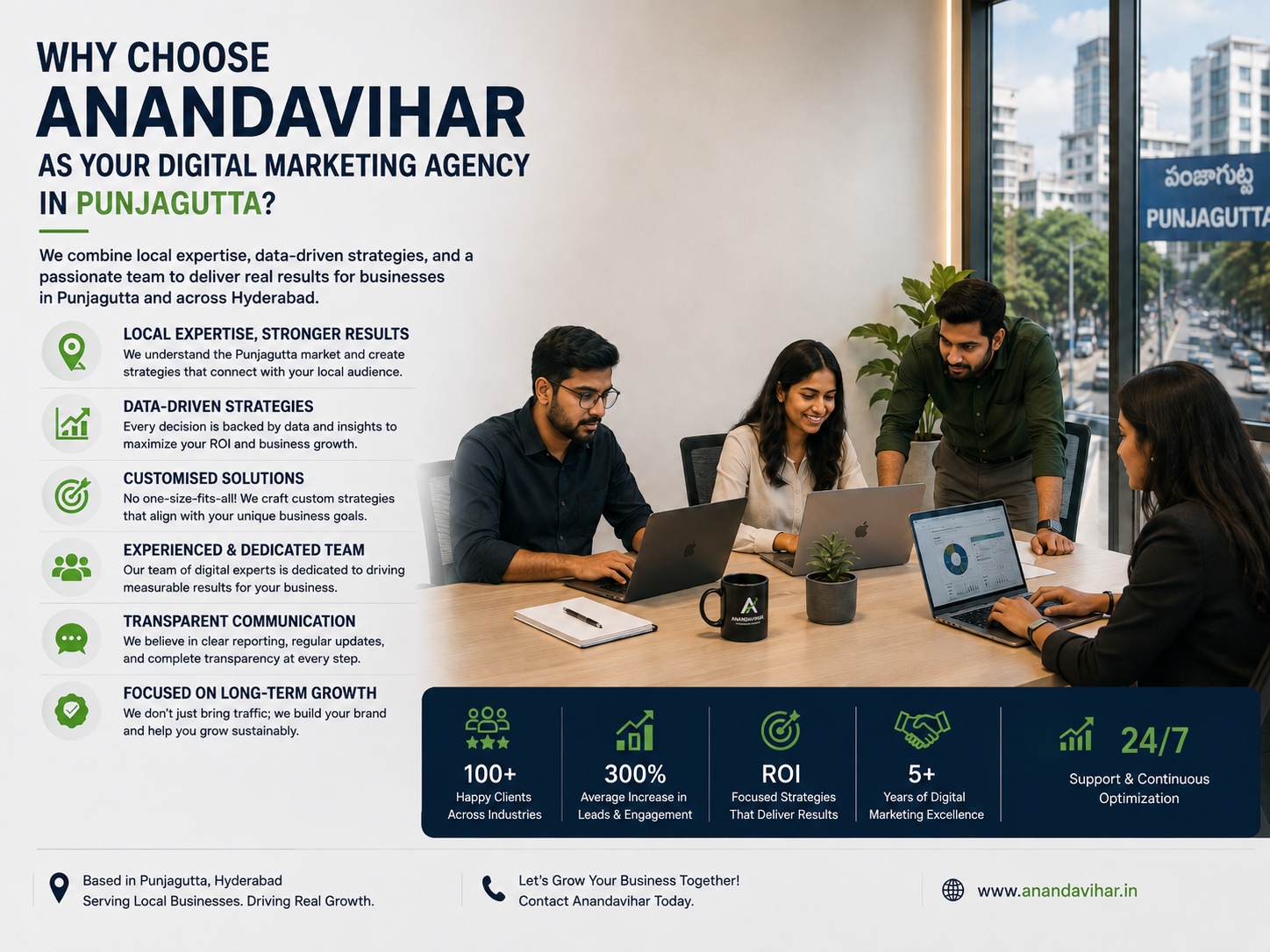
Anandavihar combines local Hyderabad understanding with integrated digital marketing execution.
Local Market Understanding
Businesses in Punjagutta compete with providers across central and western Hyderabad. Strategies should reflect local search patterns, nearby commercial areas, customer travel behaviour, and location-based competition.
Integrated Services
Anandavihar supports:
- Search engine optimisation
- Local SEO
- Google Business Profile optimisation
- Google Ads
- Meta Ads
- Social media marketing
- Website development
- Landing pages
- Content marketing
- Performance marketing
- Analytics and conversion tracking
This makes it easier to align search visibility, advertising, content, and conversion performance.
Conversion-Focused Execution
Traffic is useful only when it supports a business objective.
The focus is placed on:
- Qualified enquiries
- Calls
- WhatsApp conversations
- Bookings
- Purchases
- Lead quality
- Cost efficiency
- Customer acquisition
Transparent Communication
Clients should understand what is being done and why.
Anandavihar’s approach emphasises clear explanations, agreed deliverables, regular updates, and practical next steps.
Continuous Optimisation
Digital campaigns rarely perform at their best from the first version.
Search terms, advertisements, creative formats, landing pages, audiences, and content are reviewed and improved over time.
Tailored Strategy
A hospital should not receive the same plan as a fashion brand. A school should not be marketed like a real estate project. A local professional service should not automatically be given an e-commerce strategy.
Recommendations should reflect the business model.
A Practical 90-Day Digital Marketing Roadmap
The first 90 days should create a reliable foundation, launch priority activity, and produce enough data for informed optimisation.
Days 1–30: Foundation
Key activities may include:
- Business discovery
- Competitor review
- Website audit
- SEO audit
- Google Business Profile audit
- Keyword and search-intent research
- Analytics review
- Conversion tracking setup
- Landing-page planning
- Campaign architecture
- Content calendar
- Reporting framework
Primary objective: Establish accurate information, tracking, and priorities before scaling.
Days 31–60: Launch and Improvement
Key activities may include:
- Technical SEO corrections
- Service-page optimisation
- Local landing-page development
- Google Ads launch
- Meta campaign launch
- Google Business Profile updates
- Content publication
- Creative testing
- Landing-page improvements
- Review-request process
- Search-term analysis
Primary objective: Begin generating visibility and learn which audiences, keywords, messages, and pages perform best.
Days 61–90: Optimisation and Expansion
Key activities may include:
- Budget reallocation
- Negative keyword expansion
- Audience refinement
- Creative variation
- Conversion-rate improvements
- Internal linking
- Local citation corrections
- New content opportunities
- Remarketing
- Lead-quality review
- Sales-process feedback
- Next-quarter planning
Primary objective: Improve efficiency and build on the channels producing stronger business signals.
The exact roadmap should change according to the starting condition of the business.
AI Overviews, ChatGPT, Gemini, Perplexity, and the Future of Search
Search behaviour is becoming more conversational and answer-oriented.
People may still visit Google, but they also ask ChatGPT, Gemini, Perplexity, Claude, or Microsoft Copilot for explanations, comparisons, recommendations, and summaries.
This does not make websites less important. It makes credible, structured, original websites more important.
What Businesses Should Do
- Publish clear service information
- Maintain accurate entity details
- Answer specific customer questions
- Create original expert content
- Use descriptive headings
- Build genuine brand mentions
- Link to primary sources
- Keep important pages updated
- Add relevant structured data
- Strengthen author and organisation transparency
- Avoid mass-produced generic content
- Demonstrate practical experience
Brand Authority Matters
AI systems and search engines need reasons to trust a source.
Brand authority can be supported by:
- Consistent business information
- Genuine customer feedback
- Recognised expertise
- Useful original content
- Relevant links and mentions
- Strong local presence
- Clear authorship
- Transparent policies
- Active professional profiles
- First-hand insights
No single schema type, keyword, or technical trick can manufacture authority.
Internal Linking Suggestions
Internal links help users and search engines discover related content and understand the relationship between pages.
This article should naturally link to:
|
Suggested Anchor Text |
Recommended Destination |
|
SEO services in Hyderabad |
Main SEO service page |
|
Local SEO services |
Local SEO page |
|
Google Business Profile optimisation |
GBP service page |
|
Google Ads management |
Google Ads page |
|
Meta Ads services |
Meta Ads page |
|
Website development |
Website design page |
|
Social media marketing |
Social media page |
|
Digital marketing agency in Hyderabad |
Main Hyderabad location page |
|
Contact Anandavihar |
Contact page |
|
Request a digital marketing consultation |
Lead or consultation page |
Supporting articles should also link back to this page using natural anchor text such as:
- Digital marketing agency in Punjagutta
- Digital marketing services in Punjagutta
- Choosing a marketing agency in Hyderabad
- Punjagutta digital marketing company
Avoid using the exact same anchor text for every link.
External Authority References
Relevant official sources may include:
- Google Search Essentials
- Google Search Console
- Google Business Profile Help
- Google Analytics Help
- PageSpeed Insights
- Schema.org
- Google Structured Data Documentation
- Meta Business Help Center
External links should be added when they improve accuracy or help readers verify technical information. They should not be inserted merely to increase the number of links.
Schema Markup Recommendations
Structured data helps search engines understand page content, but it does not guarantee rich results.
Google recommends using supported structured data accurately and ensuring that markup matches visible page content. Official guidance is available in Google’s structured data documentation.
Article Schema
Article schema may include:
- Headline
- Description
- Author
- Publisher
- Date published
- Date modified
- Featured image
- Main entity of page
- Canonical URL
Do not add false author credentials or inaccurate publication dates.
Organization Schema
Organization schema may include:
- Official name
- Website
- Logo
- Contact details
- Social profiles
- Founding information, when verified
- SameAs references
LocalBusiness Schema
LocalBusiness markup may be appropriate when the business has an eligible physical location or clearly defined local operations.
Potential properties include:
- Name
- URL
- Telephone
- Address
- Area served
- Opening hours
- Service type
- Logo
- Image
- Price range, where meaningful
All details should match visible information on the website and other official profiles.
Breadcrumb Schema
Breadcrumb markup helps describe the page’s position within the website hierarchy.
Example structure:
Home → Locations → Punjagutta → Digital Marketing Agency
FAQ Schema
FAQ content should be visible on the page and should contain genuine questions and answers.
Adding FAQ schema does not guarantee an enhanced search appearance. The main value of FAQs is helping users find clear answers.
Review Schema
Review markup must be used carefully.
Do not:
- Create fake reviews
- Mark up reviews copied from unrelated platforms without understanding policy
- Add ratings that are not visible
- Use self-serving review markup in ways that violate search guidelines
- Aggregate ratings without a valid source
Schema should describe reality, not create the appearance of credibility.
Frequently Asked Questions
1. Which is the best digital marketing agency in Punjagutta?
The best agency is the one that understands your business, tracks conversions, communicates clearly, and improves campaigns based on lead quality and sales outcomes. Anandavihar offers integrated SEO, Google Ads, Meta Ads, local SEO, website development, content, and performance marketing for businesses in Punjagutta and Hyderabad.
2. What services does a digital marketing agency provide?
A digital marketing agency may provide SEO, local SEO, Google Ads, Meta Ads, social media marketing, content creation, website development, landing pages, analytics, conversion tracking, and online reputation support. The recommended mix should depend on your goals.
3. Why should I hire a local digital marketing agency?
A local agency may understand neighbourhood competition, Hyderabad customer behaviour, location-based searches, and local business challenges more clearly. It can also tailor campaigns to areas you genuinely serve.
4. Does my business need both SEO and Google Ads?
Many businesses benefit from both. Google Ads can create faster search visibility, while SEO builds longer-term organic presence. The correct balance depends on budget, competition, urgency, and existing website authority.
5. How long does SEO take to show results?
SEO timelines vary according to competition, website condition, content quality, indexing, location, and authority. Initial improvements may appear earlier, but meaningful commercial growth usually requires consistent work rather than a one-time update.
6. Can an agency guarantee first-page rankings?
No ethical agency can guarantee a specific organic position. Search results change based on competition, location, relevance, website quality, search intent, and search-engine systems.
7. How much should I spend on digital marketing?
The budget should reflect your customer value, growth target, competition, sales capacity, and chosen channels. Agency fees, advertising budget, website work, and content production should be considered separately.
8. Is digital marketing suitable for small businesses?
Yes. Small businesses can use local SEO, Google Business Profile, focused advertising, helpful content, and conversion-friendly websites to compete within relevant locations and niches.
9. What is local SEO?
Local SEO improves a business’s visibility for geographically relevant searches. It includes Google Business Profile optimisation, location content, reviews, consistent business information, local citations, and locally relevant website signals.
10. How can I rank my Google Business Profile?
Maintain accurate information, choose relevant categories, publish useful updates, add genuine photos, describe services clearly, earn honest reviews, respond professionally, and keep website and citation information consistent.
11. Do Google Business Profile posts improve rankings?
Posts help keep the profile useful and active, but posting alone does not guarantee ranking improvement. Relevance, proximity, prominence, categories, reviews, website signals, and overall profile quality also matter.
12. Are reviews important for local SEO?
Reviews influence customer trust and can support local prominence. Businesses should focus on earning genuine feedback and responding professionally rather than purchasing or manufacturing reviews.
13. What is the difference between SEO and local SEO?
SEO targets broader organic visibility, while local SEO focuses on searches connected to a specific area or nearby customer. Local SEO places greater emphasis on Google Business Profile, maps, reviews, citations, and location relevance.
14. What is performance marketing?
Performance marketing focuses on measurable actions such as leads, bookings, purchases, or customer acquisition. It uses tracking and continuous optimisation to improve the efficiency of marketing spending.
15. Why are my Google Ads getting clicks but no leads?
Possible reasons include irrelevant keywords, weak landing pages, poor location targeting, unclear offers, missing trust signals, technical problems, or incorrect conversion tracking. Search-term and landing-page analysis can identify the main issue.
16. Why are my Meta Ads generating low-quality leads?
Low-quality Meta leads may result from broad messaging, weak qualification, an overly attractive free offer, accidental submissions, slow follow-up, or poor audience alignment. Creative and lead-form design should be reviewed together.
17. Should I send ad traffic to my homepage?
Usually, campaign traffic performs better when directed to a relevant landing page. The page should closely match the advertisement, keyword, audience, and offer.
18. What is a landing page?
A landing page is a focused page designed for a specific campaign, service, or audience. It usually contains a clear message, supporting information, trust signals, and one primary action.
19. How do I know whether an agency is performing well?
Review qualified leads, conversion rates, cost per acquisition, sales feedback, organic visibility, campaign efficiency, and completed deliverables. Do not judge performance using reach or impressions alone.
20. What should be included in a monthly marketing report?
A report should include completed work, key performance changes, leads, campaign costs, conversion data, search terms, website insights, issues found, and next-month actions.
21. Will I own my Google Ads and Meta Ads accounts?
Your business should generally retain ownership or suitable administrative access. Account ownership and access should be agreed before work begins.
22. Do I need a website for digital marketing?
A website is strongly recommended because it gives you control over service information, search visibility, landing pages, tracking, content, and conversion experience. Some businesses can begin with Google Business Profile or social platforms, but a website provides a stronger long-term foundation.
23. Can I run digital marketing without social media?
Yes. Some businesses generate results mainly through SEO, Google Ads, email, partnerships, or local search. Social media should be used when it supports the audience and buying journey.
24. How often should my business post on social media?
Frequency should depend on content quality, audience expectations, resources, and platform strategy. Consistency matters, but posting weak content every day is not automatically effective.
25. What is conversion tracking?
Conversion tracking records valuable user actions such as calls, forms, bookings, purchases, or WhatsApp enquiries. It helps identify which campaigns contribute to business results.
26. What is Google Analytics 4?
Google Analytics 4 is an analytics platform for measuring website and app behaviour. It can help businesses understand traffic sources, content engagement, user journeys, and configured conversion events.
27. What is Google Search Console?
Google Search Console is a tool that helps website owners monitor search visibility, indexing, search queries, technical issues, and selected performance information from Google Search.
28. What are Core Web Vitals?
Core Web Vitals are user-experience measurements related to loading performance, responsiveness, and visual stability. They are useful for identifying page-experience issues but should be improved alongside content and usability.
29. What is AEO?
Answer Engine Optimisation structures content so search engines and assistants can understand and present clear answers. It uses direct explanations, definitions, tables, FAQs, and logical headings.
30. What is GEO?
Generative Engine Optimisation improves the clarity, credibility, and structure of content for AI-generated answers. It focuses on strong entity information, original expertise, supported claims, and easy-to-understand explanations.
31. Can an agency guarantee that ChatGPT or Google AI Overviews will cite my website?
No. No agency controls which sources an AI platform selects. A business can improve its chances by publishing original, reliable, entity-rich, well-structured, and authoritative content.
32. What is entity SEO?
Entity SEO helps search engines understand a business as a defined organisation connected to services, locations, people, websites, and other entities. Consistent brand information supports this understanding.
33. What is topical authority?
Topical authority is the depth and credibility a website develops around a subject. It is strengthened by publishing connected, useful content that demonstrates genuine expertise.
34. Should I create separate pages for every Hyderabad location?
Create location pages only when the business genuinely serves those areas and can provide useful, location-specific information. Avoid producing dozens of nearly identical pages with only the place name changed.
35. Is keyword density still important?
There is no useful universal keyword-density target. Keywords should appear naturally where they help explain the topic. Repetition that damages readability or adds no value should be avoided.
36. How many keywords should one page target?
A page should focus on one main search intent while naturally covering related terms, questions, entities, and subtopics. It can rank for many relevant queries without targeting each one mechanically.
37. Are backlinks still important?
Relevant, genuine links and brand mentions can support authority and discovery. Quality, relevance, and credibility are more valuable than a large quantity of unrelated links.
38. Can I buy backlinks to rank faster?
Buying low-quality or manipulative backlinks can create long-term risk. Sustainable link acquisition comes from useful content, partnerships, digital PR, industry contributions, and genuine business relationships.
39. Should digital marketing agencies provide content writing?
Content is central to SEO, advertising, landing pages, social media, and customer education. An agency should either provide strong content capability or coordinate closely with a qualified writer.
40. How quickly should my team respond to online leads?
As quickly as practical during business hours. Customers often contact several providers, so delays can reduce conversion even when the marketing campaign performed correctly.
41. What information should I give my marketing agency?
Provide service details, pricing context, customer profiles, service locations, sales feedback, common objections, business goals, past campaign information, and access to relevant digital assets.
42. Can digital marketing help a new business?
Yes. A new business can use local SEO, search advertising, social media, content, and a strong website to establish visibility. The strategy should also build trust because the brand may not yet have reviews or recognition.
43. Can digital marketing help an established offline business?
Yes. Established businesses often have valuable reputation and customer knowledge but weak online visibility. Digital marketing can translate existing credibility into searchable content, reviews, local listings, advertisements, and stronger customer journeys.
44. What industries can Anandavihar support?
Anandavihar can develop strategies for local businesses, professional services, education, healthcare, real estate, e-commerce, retail, hospitality, and other growth-focused organisations. The exact plan should be based on the industry’s buying process and advertising requirements.
45. How do I contact Anandavihar?
Visit https://anandavihar.in/ or call or WhatsApp +91 98491 32909 to discuss your business, current marketing challenges, and suitable next steps.
Final Recommendation
The best digital marketing agency in Punjagutta should help you make better business decisions, not simply deliver more marketing activity.
Look for a team that asks serious questions about your customers, sales process, margins, locations, lead quality, and long-term goals. Make sure tracking is established, account ownership is clear, reports are understandable, and recommendations are supported by evidence.
Anandavihar provides integrated digital marketing services for businesses in Punjagutta and across Hyderabad, including SEO, local SEO, Google Business Profile optimisation, Google Ads, Meta Ads, social media marketing, website development, landing pages, content marketing, and conversion tracking.
The objective is straightforward: attract the right audience, create a credible digital experience, measure customer actions, and continually improve the path from search or advertisement to genuine business enquiry.
Speak with Anandavihar
Website: https://anandavihar.in/
Phone and WhatsApp: +91 98491 32909